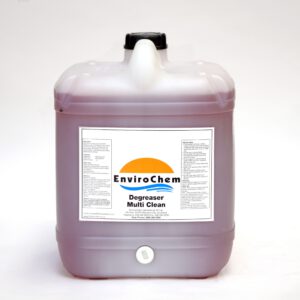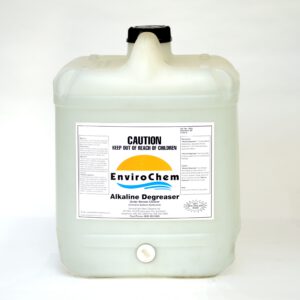
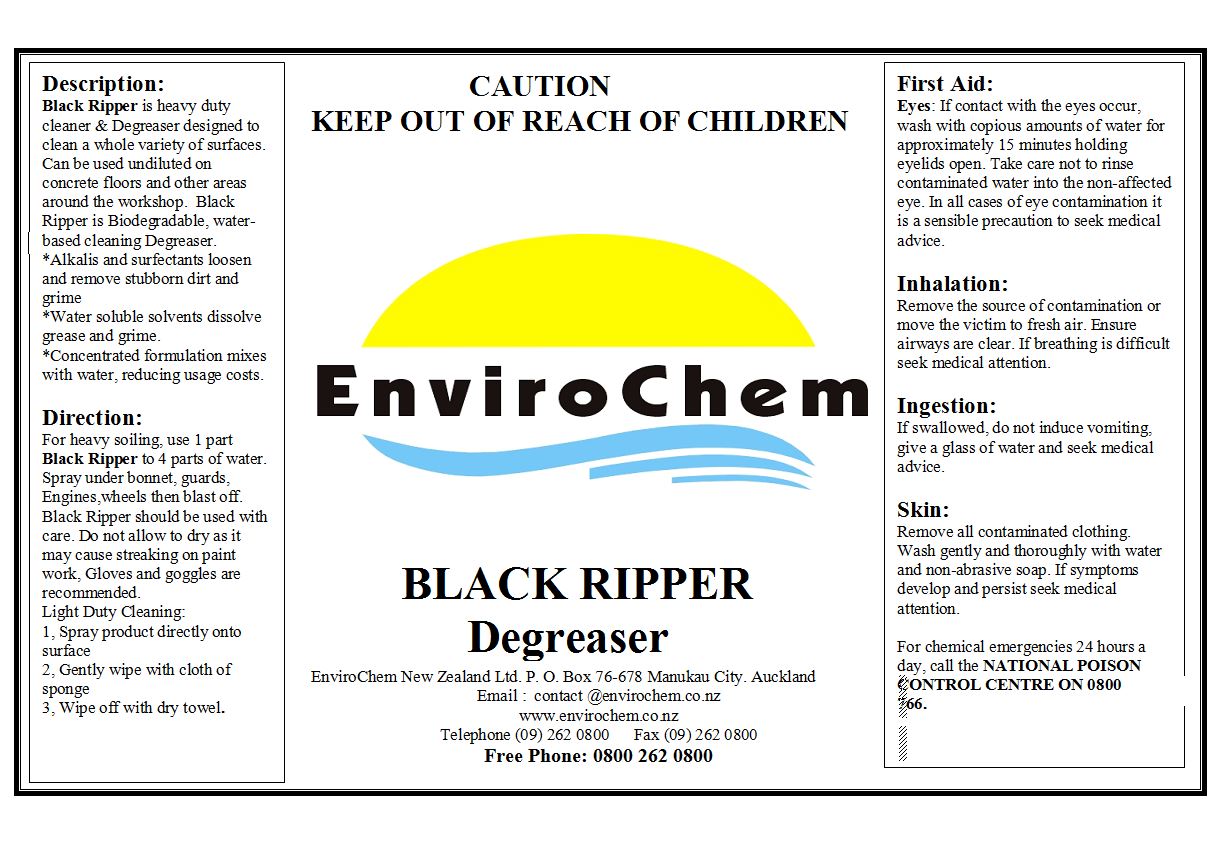
Black Ripper Degreaser is a high‑performance commercial cleaning solution designed for reliable results in demanding environments. Formulated for professional use, it delivers effective cleaning action across a wide range of surfaces and applications. This product supports routine maintenance as well as intensive cleaning tasks, providing consistent performance, ease of use, and dependable results. Its versatility makes it suitable for industrial, commercial, and facility‑care settings, helping users maintain clean, safe, and well‑presented surfaces. Developed with efficiency and practicality in mind, Black Ripper Degreaser ensures optimal outcomes with minimal effort, making it an essential choice for organisations seeking professional‑grade cleaning performance.
Product & Company Identification
Document Header: ENVIROCHEM INTERNATIONAL (NZ) LTD | www.envirochem.co.nz — Page 1 of 5
Safety Data Sheet
Product Name: Black Ripper
Recommended Use: Heavy Duty Degreaser
Company Details: Envirochem International (NZ) Ltd
Address: 41 Angle Street, Onehunga, Auckland, New Zealand
Telephone Number: +64 9 262 0800
Emergency Telephone Number: National Poison Information Centre 0800 764 766
Date of Preparation: 01/06/2017
Hazard Identification
Signal Word: CORROSIVE
HSNO Hazard Classification: 3.1D, 6.1E, 8.2C, 8.3A
Hazard Statements:
- May be harmful if swallowed
- May be corrosive to metal
- Causes severe skin burns and eye damage
- Causes serious eye damage
Prevention Statements:
- Keep out of reach of children
- Read label before use
- Wash hands thoroughly after handling
- Keep away from flames/hot surfaces. No smoking.
- Use personal protective equipment as required
- Do not breathe fume/gas/dust/mist
- Keep in original container
Response Statements:
- If medical advice is needed, have product container or label at hand
- Absorb spillage to prevent material damage
- IF SWALLOWED: Rinse mouth. DO NOT induce vomiting
- IF ON SKIN (or hair): Remove/Take off immediately all contaminated clothing. Rinse skin with water/shower
- Wash contaminated clothing before use
- IF INHALED: Remove to fresh air and keep at rest in a position comfortable for breathing
- Immediately call a POISON CENTRE or doctor/physician
- IF IN EYES: Rinse cautiously with water for several minutes. Remove contact lenses, if present and easy to do, continue rinsing
Storage Statements:
- Store in corrosive resistant container with a resistant inner liner
- Store locked up
Disposal:
- Disposal should be through qualified contractor.
Composition / Information on Ingredients
Ingredients:
| Ingredient | CAS # | Concentration % |
|---|---|---|
| Sodium Metasilicate | 10213-79-3 | 5.0–10.0 |
| 2 Butoxy Ethanol | 111-76-2 | 5.0–10.0 |
| Sodium Hydroxide | 1310-73-2 | 10.0–20.0 |
| Non-ionic surfactant | Not specified | 5.0–10.0 |
| Water | 7732-18-5 | 50.0–80.0 |
First Aid Measures
Ingestion: Immediately rinse mouth with water. If swallowed do not induce vomiting. Give water to drink. Never give anything by mouth to an unconscious person. Seek immediate medical aid.
Eye Contact: Immediately flush eyes with large amounts of water for at least 15 minutes while holding eyelids open. Transport to the nearest medical facility for additional treatment. Do not rub eyes or keep eyes closed.
Skin Contact: Remove contaminated clothing. Flush exposed area with water and follow by washing with soap if available.
Inhalation: Remove the affected person to a ventilated area. If not breathing, give artificial respiration. If breathing is difficult, give oxygen. Seek medical attention.
Fire Fighting Measures
Extinguishing Media: Use dry chemical powder, foam, polymer foam, and water spray or fog type extinguishers. Water may be ineffective on fire. However, water spray may be used to extinguish fires and to absorb heat. Keep containers cool and protect exposed material. If a leak or spill has not ignited, water spray may be used to flush spills away from exposures.
Hazards from Combustion Products: Evaporation of aqueous component may leave residual material that can burn if ignited. While burning, it will emit toxic fumes including carbon monoxide and carbon dioxide.
Precautions for Fire Fighters and Special Protective Equipment: Fire fighters should wear self-contained breathing apparatus if there is risk of exposure to vapour or combustion products, as well as structural firefightersu2019 uniform.
Accidental Release Measures
Emergency Precautions: Personnel involved in the clean up should wear full protective clothing. Evacuate all unnecessary personnel. Increase ventilation. Avoid walking through spilled product as it may be slippery. Stop leak if safe to do so. Do not let product reach drains or waterways; advise the Environmental Protection Authority or your local Waste Management. Use clean, non-sparking tools and equipment.
Methods and Materials for Containment and Clean Up: Soak up spilled product using absorbent, non-combustible material such as sand or soil. Avoid using sawdust or cellulose. When saturated, collect material into suitable, labelled, dry, sealable containers and hold for safe disposal. Once pick-up is complete, flush spill site with plenty of water to eliminate any residue. Hold contaminated water for treatment/disposal.
Handling & Storage
Handling: Wash thoroughly after handling. Use only in a well ventilated area. Avoid contact with eyes, skin and clothing. Empty containers retain product and residue (liquid or vapour), and can be dangerous. Keep container tightly closed. Always wash hands before smoking, eating or using the toilet. Wash contaminated clothing and other protective equipment before storage or re-use. Do not dispose of material to sewers or waterways.
Storage: Store in a tightly closed container. Store in a cool, dry, well-ventilated area away from incompatible substances. Keep containers closed at all times and check regularly for leaks.
Exposure Controls & Personal Protection
Exposure Standards: The Occupational Safety and Health Service, NZ Department of Labour have set no Tolerable Exposure Limit (TEL) Workplace Exposure Standards (WES) for this substance.
Biological Limit Values: None established.
Engineering Controls: Use local exhaust ventilation to control process emissions near the source. Handle laboratory samples in a fume hood. Provide mechanical ventilation of confined spaces. Use explosion-proof ventilation equipment.
Personal Protective Equipment:
Respiratory Protection: Where concentration in air may exceed the limits described in the National Exposure Standards, use a half face filter mask to protect from overexposure by inhalation. A type u201cAu201d filter material is considered suitable for this product.
Eye Protection: Always use safety glasses or a face shield when handling this product.
Skin/Body Protection: Always wear long sleeves and long trousers or coveralls, enclosed footwear or safety boots and chemical resistant gloves when manufacturing or handling this product.
Physical & Chemical Properties
Appearance: Clear black
Physical State: Liquid
Odour: Odourless
pH: 12–13
Solubility: Soluble in water
Vapour Density: Not available
Boiling Point: >100 °C
Freezing Point: 0 °C
Ignition Point: Not available
Flash Point: Not available
Specific Gravity: 1.04
Vapour Pressure: Not available
% Volatiles: Not available
Stability & Reactivity
Chemical Stability: Stable at room temperature and pressure.
Conditions to Avoid: Avoid excessive heat, direct sunlight, moisture, high temperatures.
Incompatible Materials: Incompatible with oxidizing agents, acidic agents and sources of ignition.
Hazardous Decomposition: When involved in a fire, this product will generate carbon monoxide. Also incompatible with oxidizing agents, acidic agents (including acidic clays) and sources of ignition.
Hazardous Reactions: Oxidizing agents, mineral acids, halogenated organic compounds.
Toxicological Information
No adverse health effects are expected if the product is handled in accordance with the safety data sheet. Symptoms or effects that may arise if the product is mishandled and overexposure occurs are detailed below.
Acute Effects
Ingestion: Small amounts of liquid aspirated into lungs during ingestion, or from vomiting. Ingestion of large amounts of this product will result in headaches, nausea, dizziness and tracheal burning.
Eye Contact: This product is irritating and causes pain followed by swelling to the conjunctiva.
Skin Contact: This product is irritating to skin.
Inhalation: Irritating to respiratory tract. Exposure to high concentrations over an extended period of time may result in muscle weakness, tingling in hands and feet, blurred vision, headaches, nausea, loss of appetite, hallucinations and possible loss of consciousness.
Ecological Information
Persistence/Degradability: No data available for this product.
Mobility: No data available for this product. Avoid contaminating waterways.
Disposal Considerations
Disposal Methods: Empty packaging should be taken for recycling, recovery or disposal through a suitably qualified or licensed contractor. Care should be taken to ensure compliance with national and local authorities.
Transport Information
Road and Rail Transport: Classified as Dangerous Goods by the criteria of New Zealand Dangerous Goods Code for transport by road and rail.
Shipping Name: CORROSIVE LIQUID, BASIC, INORGANIC, N.O.S.
Hazard Class: 8
UN Number: UN 3266
Packing Group: III
Hazchem Code: 2X
Regulatory Information
HSNO Approval No: HSR002527
Group Standard: Cleaning Products (Corrosive, Combustible) Group Standard 2006
HSNO Classification: 3.1D, 6.1E, 8.2C, 8.3A
Other Information
Document Footer: ENVIROCHEM INTERNATIONAL (NZ) LTD | www.envirochem.co.nz — Page 5 of 5
New Zealand National Poison Information Centre: 0800 764 766
New Zealand Emergency Services: 111
Envirochem International (NZ) Ltd: +64 9 262 0800
Disclaimer: Every endeavour has been made to ensure that the information contained in this publication is reliable and offered in good faith. It is meant to describe the safety requirements of our products and should not be construed as guaranteeing specific properties. Customers are encouraged to conduct their own tests as end user suitability of the product for particular uses is beyond our control. The information is not intended as an inducement to bargain and no warranty expressed or implied is made as to its accuracy, reliability or completeness. Envirochem International (NZ) Limited accepts no liability for loss, injury or damage arising from reliance upon the information contained in this data sheet except in conjunction with the proper use of the product to which it refers. Due care should be taken that the use and disposal of this product is in compliance with appropriate Local Councils regulations.