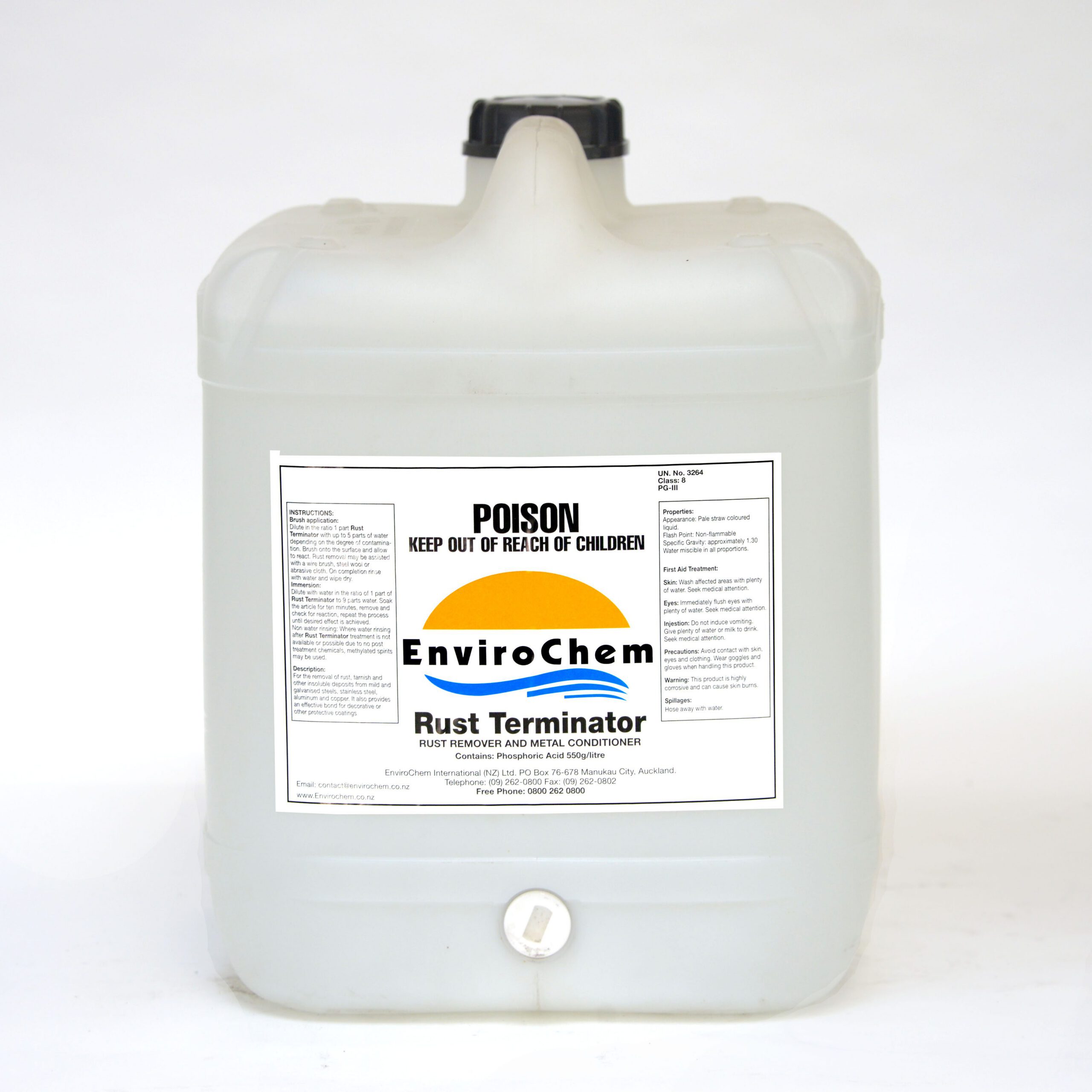
Rust Terminator is a high‑performance commercial cleaning solution designed for reliable results in demanding environments. Formulated for professional use, it delivers effective cleaning action across a wide range of surfaces and applications. This product supports routine maintenance as well as intensive cleaning tasks, providing consistent performance, ease of use, and dependable results. Its versatility makes it suitable for industrial, commercial, and facility‑care settings, helping users maintain clean, safe, and well‑presented surfaces. Developed with efficiency and practicality in mind, Rust Terminator ensures optimal outcomes with minimal effort, making it an essential choice for organisations seeking professional‑grade cleaning performance.
Trade pricing
Pricing is available to approved trade accounts. Sign in to view your rate, or request a quote below.
Sign inProduct & Company Identification
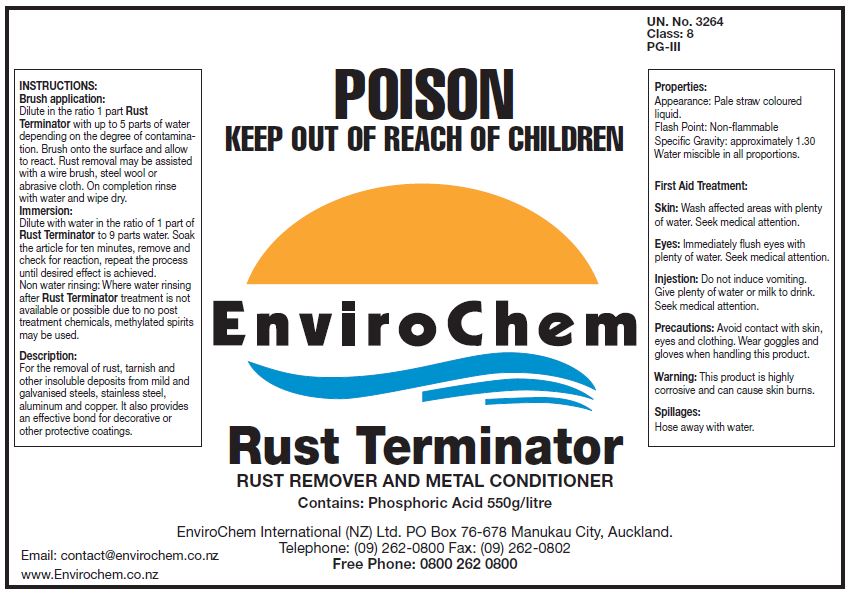
Product name: Rust Terminator
Recommended use: Rust Treatment Chemical
Company details:
Envirochem International (NZ) Ltd
41 Angle Street, Onehunga
Auckland, New Zealand
Telephone number: +64 9 262 0800
Emergency telephone number: National Poison Information Centre 0800 764 766
Date of preparation: 01/06/2017
Hazard Identification
DANGER
HSNO Hazard Classification: 6.1D (Oral), 6.1E (Dermal), 8.1A, 8.2C, 8.3A, 9.1D, 9.3C
Hazard statements:
- May be corrosive to metals.
- Harmful if swallowed.
- May be harmful in contact with skin.
- Causes severe skin burns and eye damage.
- Causes serious eye damage.
- Harmful to aquatic life.
- Harmful to terrestrial vertebrates.
Prevention statements:
- Keep out of reach of children.
- Read label before use.
- Read Safety Data Sheet before use.
- Keep in original container.
- Do not breathe dust/mist.
- Wash hands thoroughly after handling.
- Do not eat, drink or smoke when using product.
- Avoid release into environment.
- Use personal protective equipment as required.
Response statements:
- If medical advice is needed, have product container or label at hand.
- Immediately call a POISON CENTRE or doctor/physician.
- Call a POISON CENTRE or doctor/physician if you feel unwell.
- Rinse mouth.
- Do NOT induce vomiting.
- Wash contaminated clothing before reuse.
- Absorb spillage to prevent material damage.
- IF SWALLOWED: Call a POISON CENTRE or doctor if you feel unwell.
- IF SWALLOWED: Rinse mouth. Do NOT induce vomiting.
- IF ON SKIN (or hair): Remove contaminated clothing. Rinse skin with water/shower.
- IF INHALED: Remove to fresh air and keep at rest.
- IF IN EYES: Rinse with water for several minutes; remove lenses if easy to do so.
Storage statement:
- Store locked up.
- Store in a corrosive resistant container with a resistant inner lining.
Disposal: Disposal should be through a qualified contractor.
Composition / Information on Ingredients
| Ingredient | CAS # | Concentration % |
|---|---|---|
| Phosphoric Acid | 7664-38-2 | 20-50 |
| Non-ionic surfactant | - | >10 |
| Water | 7732-15-5 | Balance |
First Aid Measures
Ingestion: Rinse mouth. Do not induce vomiting. Give water. Never give anything by mouth to an unconscious person. Seek medical aid immediately.
Eye contact: Flush with water for at least 15 minutes. Seek medical attention.
Skin contact: Remove contaminated clothing. Wash with water and soap.
Inhalation: Move to fresh air. If not breathing, give artificial respiration. If breathing is difficult, give oxygen. Seek medical attention.
Fire Fighting Measures
Extinguishing media: Dry chemical powder, foam, polymer foam, water spray or fog.
Hazards from combustion: Not combustible, but residues may burn producing CO and COu2082.
Precautions:
- Alert fire brigade.
- Wear breathing apparatus and gloves.
- Prevent spillage from entering drains or waterways.
- Use water spray to control fire and cool surrounding areas.
- Firefighters should wear SCBA and structural gear.
Accidental Release Measures
Emergency precautions: Wear protective clothing. Evacuate unnecessary personnel. Increase ventilation. Avoid slipping. Prevent entry to drains or waterways.
Clean-up:
- Absorb with sand or soil (not sawdust or cellulose).
- Collect into sealed labelled containers.
- Flush area with plenty of water.
- Hold contaminated water for disposal.
Handling & Storage
Handling: Wash after handling. Use in well-ventilated area. Avoid contact with eyes, skin and clothing. Empty containers may contain residue. Keep container tightly closed. Do not dispose into waterways.
Storage: Store tightly closed. Keep away from oxidizing agents. Store cool, dry, well-ventilated. Check regularly for leaks.
Exposure Controls / Personal Protection
Exposure standards: No TEL/WES established.
Biological limit values: None.
Engineering controls: Use local exhaust ventilation. Handle samples in fume hood. Provide mechanical ventilation in confined spaces.
PPE:
- Respiratory: Half-face A-filter mask if airborne exposure exceeds limits.
- Eye: Safety glasses or face shield.
- Skin: Long sleeves, coveralls, chemical-resistant gloves, enclosed footwear.
Physical & Chemical Properties
Appearance: Colourless
Physical state: Liquid
Odour: Odourless
pH: 4.0u20135.0
Solubility: Soluble in water
Vapour density: Not available
Boiling point:>100u00b0C
Freezing point: Not available
Ignition point: Not available
Flash point: Not available
Specific gravity: 1.50
Vapour pressure: Not available
% Volatilities: Not available
Stability & Reactivity
Stability: Stable under normal conditions.
Conditions to avoid: Excessive heat, direct sunlight, moisture.
Incompatible materials: Alkali and oxidizing agents.
Hazardous decomposition: Thermal decomposition may produce fumes of phosgene and chlorides.
Toxicological Information
No adverse health effects expected with proper handling.
Ingestion: May cause headaches, dizziness, nausea, tracheal burning.
Eye contact: Irritating; may cause swelling and pain.
Skin contact: Irritating to skin.
Inhalation: May irritate respiratory tract; prolonged exposure may cause neurological effects.
Additional info: Constituents cause severe skin burns and eye damage.
Toxicological data:
- Oral LD50 (Rat): 1530 mg/kg
- Dermal: Corrosive (Rabbit)
- Oral: Severely irritating (Rabbit)
Ecological Information
Persistence/degradability: No data.
Mobility: No data.
Ecological toxicity: Rat LD50 1530 mg/kg
Disposal Considerations
Dispose through licensed contractor. Packaging may contain harmful vapours.
Not suitable for landfill or sewer disposal. Product is ashless and may be burned in appropriate equipment.
Transport Information
Road/Rail: Dangerous Goods
Marine: Dangerous Goods
Air: Dangerous Goods
Shipping name: Corrosive Liquid, Acidic, Inorganic, N.O.S
Hazard class: 8
UN number: UN 3264
Packing group: II
Hazchem code: 2R
Regulatory Information
HSNO Approval No: HSR002526
Group Standard: Cleaning Products Corrosive Group Standard 2006
Classification: 6.1D (oral), 6.1E (Dermal), 8.1A, 8.2C, 8.3A, 9.1D, 9.3C
Other Information
National Poison Centre: 0800 764 766
Emergency Services: 111
Envirochem International: +64 9 262 0800
Information provided in good faith without warranty. Users must determine suitability. Envirochem accepts no liability for misuse. Follow all local regulations for handling and disposal.